

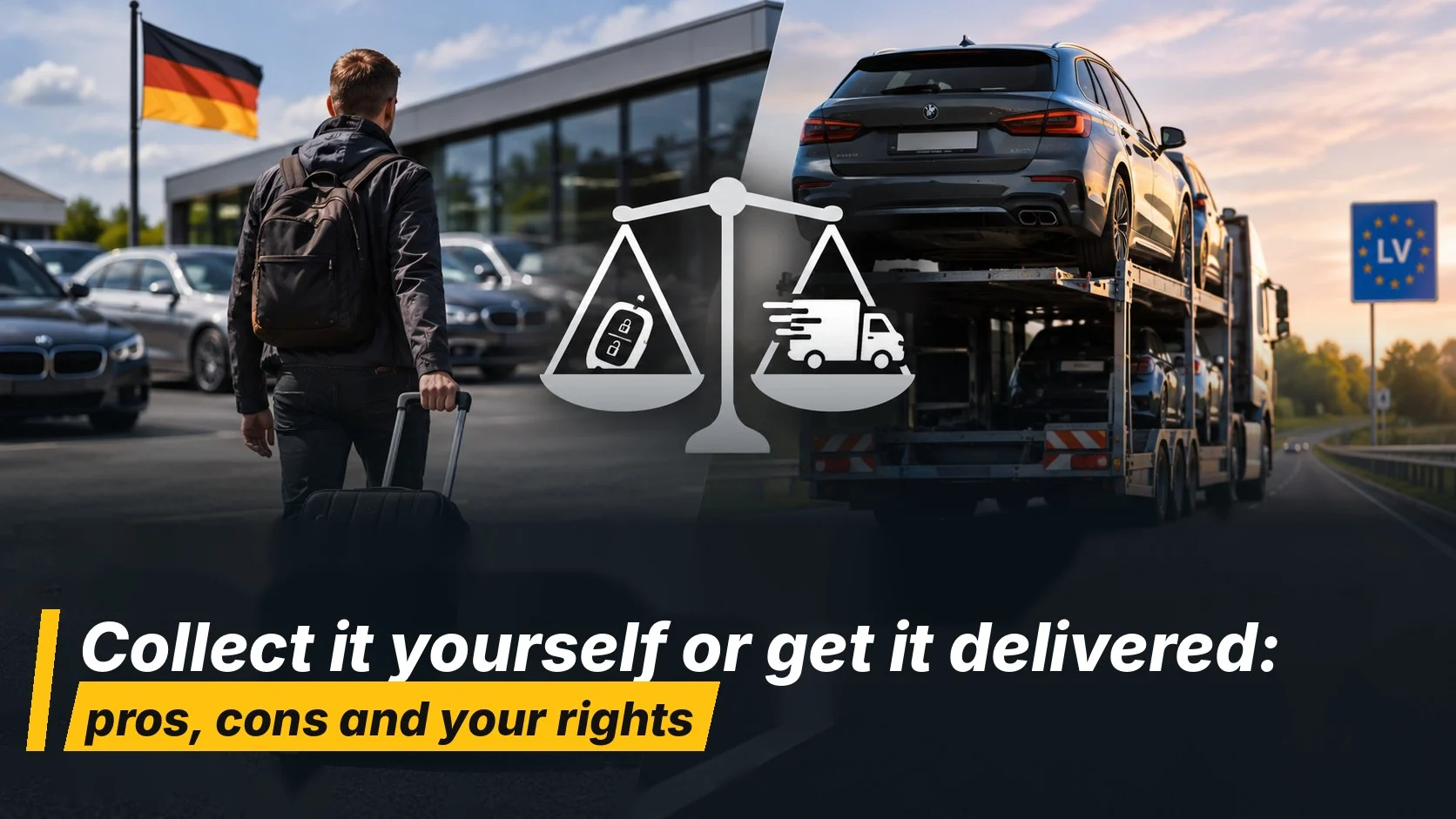
Picking up the car yourself or arranging for it to be delivered: pros, cons and your rights
You can import a car from abroad yourself or use a company to source, inspect and deliver it for you. The difference lies not only in the price and timeframe, but also in who will be liable if a fault is discovered a month later. Here is an honest comparison.
1 The most important thing is: who are you legally buying from?
Your rights are determined not by who imported the car, but by who is selling it to you. If you buy from a trader (a dealer or a company), EU consumer rights stipulate that the seller is liable for any lack of conformity that existed at the time of delivery and is discovered within two years. If a lack of conformity is discovered within the first year, it is presumed to have existed at the time of delivery, and the seller must prove otherwise. If you buy from a private individual, these consumer rights do not apply.
2 The finer points of buying a second-hand car
EU Directive 2019/771 allows countries to set a shorter warranty period for second-hand goods, but not less than one year. Therefore, a contract with a foreign dealer may specify a warranty period of one year. In Latvia, the Consumer Protection Act makes no distinction between new and second-hand goods. Any defects that you were informed of before making the purchase are not considered a lack of conformity. In Latvia, a claim for non-conformity must be lodged within two months of the date on which you discovered the issue. If you buy a car from a seller remotely (online, over the phone, without being physically present), you usually have a 14-day right of withdrawal. This right does not apply if you buy the car in person at a dealership.
3 Travelling independently: the advantages
You’ll get to see the car in person, take it for a test drive and have it checked over at the service centre on the spot. There is no intermediary’s mark-up. A wider choice: you can look at several cars at once.
4 Travelling independently: drawbacks and risks
Travel expenses: flight ticket, hotel, fuel for the return journey, export registration plates and insurance. If the car does not match the description, the trip may turn out to be a waste of time. Deposit or advance payment: before your trip, sellers often ask you to pay a booking fee. It can be difficult to recover this from a private individual abroad. Only pay a deposit to a company whose registration details and address you have checked, and provided there is a written agreement setting out the refund terms. Hidden faults: a cursory inspection won’t reveal everything (problems with the automatic gearbox, turbocharger and electronics only become apparent later on). If you’ve bought a car from a private individual abroad, you have virtually no right to make a claim. Language barriers and documents: the contract of sale, export documents, VAT arrangements. Any errors could delay registration in Latvia. Travelling back in someone else’s car: if it breaks down on the way, you’ll be responsible for the cost of towing and repairs abroad.
5 Order with delivery: the benefits
If a Latvian company buys the car itself and sells it to you, then you are buying from a Latvian trader. In this case, Latvian consumer protection laws apply, and any dispute is resolved in Latvia. There’s no need to fly there, sort out the paperwork and come back again. Companies often offer a pre-purchase inspection and an additional (commercial) warranty.
6 Ordering with delivery: drawbacks and risks
The agent’s commission and service charge. If the company acts solely as an intermediary (you are buying from an overseas seller, and the company merely sources and delivers the vehicle), then the overseas seller, not the intermediary, is liable for any defects in the car. The intermediary is liable only for its own services. Check who is named as the seller in the contract. A company’s ‘inspection’ is only as good as its report: they ask for photographs, a printout of the diagnostic scan, paint thickness measurements and a vehicle history report based on the VIN. A ‘warranty’ may be a commercial warranty with its own terms and conditions. It must not affect your statutory rights. Please read what it covers. Deposit: payable in accordance with the contract, which clearly sets out the terms and conditions in the event that the car does not match the description.
7 Check the company before signing a contract
Company registration in the Register of Enterprises (Lursoft), period of operation, address. The contract should include: the seller, the VIN, the mileage, the specification, any defects, the price, the delivery date, and what to do if the car does not match the description. Independent reviews, not just those on the company’s website. The European Consumer Centre (ECC Latvia) can help you with cross-border disputes involving sellers from the EU.
8 Which is better value?
If you’re buying from an overseas dealer, you can inspect the car yourself and, if you’re prepared to take the risk, the trip could be worth it. If you’re buying from a private individual abroad, the entire risk falls on you. If you don’t want to take that risk, it’s safer to buy from a Latvian company that is named as the seller in the contract. That way, you’ll have local consumer rights, for which you’re paying partly through a mark-up.
Sources
© 2026 Autoradars.lv. Content protected by copyright. Republishing only with written permission from Autoradars.lv and a link to the source.
Comments (0)
Log in to comment. Log in
No comments yet. Be the first!