
Cars from Europe: export discounts, number plates and documents
In the Netherlands, car dealers often offer an ‘export price’ that is thousands of euros lower. In Germany, you need export number plates; in Denmark, part of the tax is refunded. Here’s how it works and what to expect.
1 The Netherlands: why the export price is lower
In the Netherlands, the BPM registration tax is included in the price of a car. If the car is exported to another EU country (including Norway, Iceland and Liechtenstein), the remaining portion of the BPM is refunded. This depends on the car’s age and depreciation. A dealer selling a car for export receives this refund themselves and can therefore sell the car at a lower price. The amount of the discount depends on the specific car; it is often a few thousand euros. The refund applies to cars first registered on or after 16 October 2006.
2 The Netherlands: what to expect
- The car is registered for export with the RDW. This is done at an RDW office or through an export company recognised by the RDW. The RDW fee is €12; companies set their own prices. The Dutch number plates are handed over.
- An export certificate (kentekenbewijs deel II or exportbewijs) is then issued. This is required for registration in Latvia, and cannot be issued at a later date.
- Export number plates: white number plates with black characters. According to RDW data, these plates allow a vehicle to be driven in the Netherlands for 14 days; insurance is also required. Whether they are permitted for use in other countries is determined by each country individually.
- If a dealer offers “export paperwork and number plates for around €200”, this usually includes the following: export formalities, an export certificate, white number plates and temporary export insurance. Ask what exactly is included and whether the insurance (Green Card) is valid for all the countries you’ll be travelling through.
- To claim a BPM refund, the car must be registered in another EU country within 13 weeks of being granted export status, and the car must not be damaged. For this reason, the dealer often asks for proof that the car has been registered in Latvia.
- Check whether the price includes or excludes VAT. Used cars from a dealer are usually sold under a profit-sharing scheme, where VAT is not shown separately.
3 Germany: export number plates (Ausfuhrkennzeichen)
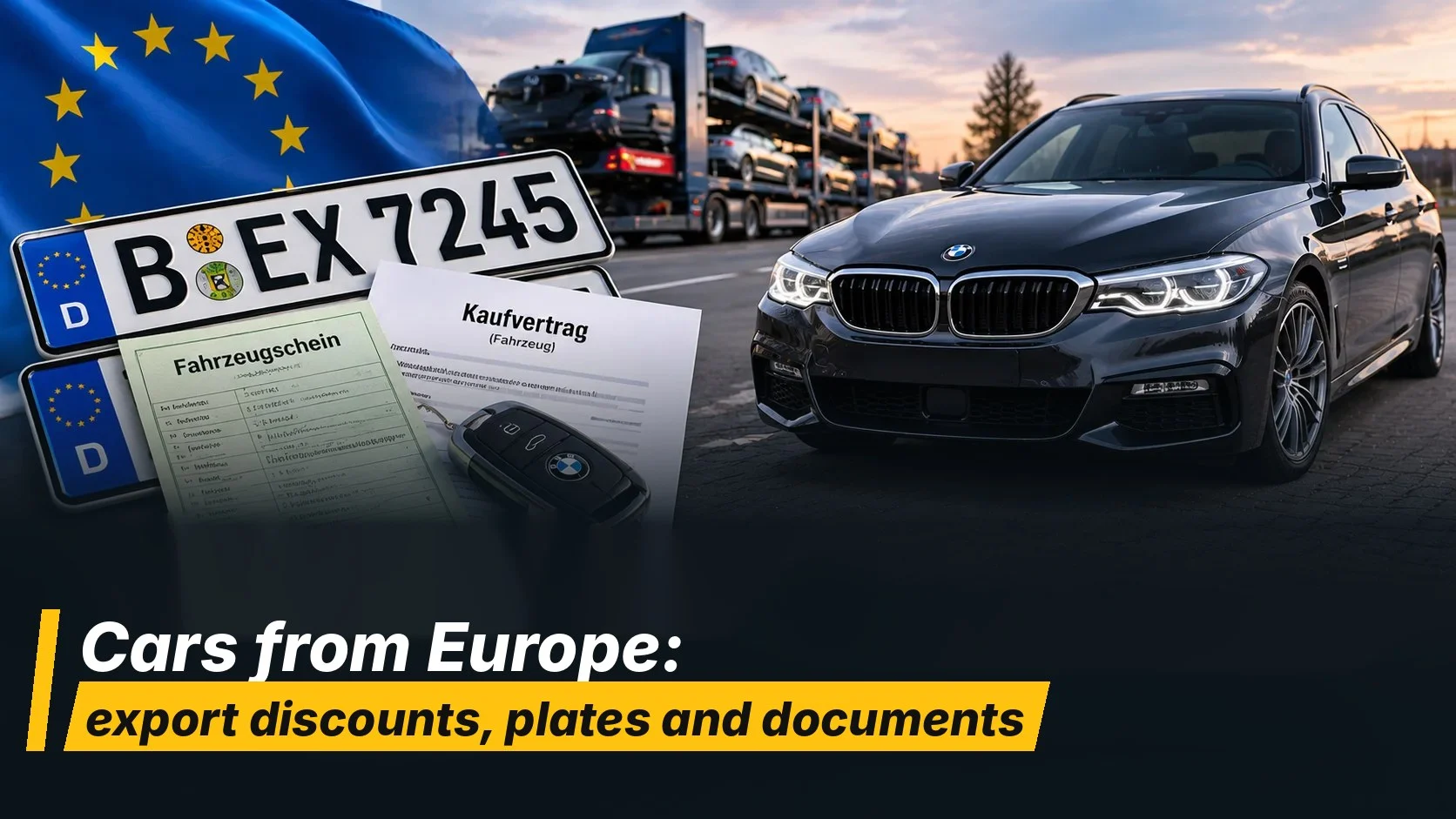
In Germany, cars are usually exported with export number plates. These are white number plates with a red band indicating the period of validity. They can be issued for a period of between 15 days and 12 months.
- Costs: registration ~25-50 €, number plates ~20-40 €, insurance from ~60 € for 15 days. In total, a short trip usually costs ~100-200 €.
- Required: vehicle documents (Zulassungsbescheinigung I and II), a valid roadworthiness test (TÜV/HU) covering the entire registration period, proof of insurance, passport.
- Many traders arrange export documents themselves for a fee. Ask about the price in advance.
- In Germany, retailers often quote a ‘Netto Export’ price excluding VAT. This is intended for businesses with a VAT number. Private individuals will still have to pay VAT, but only in Latvia.
4 Denmark: registration tax refund
Denmark has a very high registration tax, which is why cars cost more there than elsewhere. When exporting the car, part of the tax is refunded: roughly the amount you would have to pay if you were importing that car into Denmark, minus 15 per cent (and at least 8,500 DKK). The application fee is 2,250 DKK, processing takes around 9 weeks, and the car must undergo an extended inspection. Consequently, ‘export prices’ are less common in Denmark, but occasionally cars are sold with this refund factored into the price.
5 Norway: not part of the EU Customs Union
Norway is part of the EEA but is not in the EU customs union. When importing a car from Norway, you must complete a customs declaration in Latvia and pay 21 per cent VAT. If the car was manufactured outside the EEA and there is no proof of origin, an additional 10 per cent customs duty may apply. There are many electric cars and well-maintained cars in Norway, but taxes and paperwork must be factored into the price.
6 How to bring a car to Latvia
- With foreign number plates: if the car has valid foreign number plates and insurance, you may drive it into the country. Latvian residents must register their car within 5 days of purchase or import into Latvia (CSDD).
- By road haulier: the safest option from the Netherlands and further afield. Please enquire about prices in advance, as they depend on the distance.
- Latvian transit number plates (CSDD, ~€31) are primarily intended for exporting cars from Latvia or for transit, rather than for importing cars from abroad. Before making any plans, check with the CSDD.
7 Costs in Latvia following importation
For initial registration, expect to pay around €208 (natural resources tax €110, registration and number plates ~€42, engine verification ~€19, roadworthiness test ~€37) plus road tax. If the car is new (up to 6 months old or with up to 6,000 km on the clock), 21% VAT must be paid in Latvia regardless of where it was purchased. In the AutoRadars report, these costs are calculated for the specific car.
8 Before you go shopping
- Check the vehicle’s history using the VIN and ask for a service history report. In the Netherlands, you can check the mileage via the NAP system; in Germany, check the TÜV reports.
- Make sure the car is not subject to a charge or under a lease.
- Request the sales contract and the invoice, stating the VIN, price and VAT status.
- Before transferring any money, check the seller: their company registration details, reviews and address. Do not send an advance payment to a private individual whom you have not met.
© 2026 Autoradars.lv. Content protected by copyright. Republishing only with written permission from Autoradars.lv and a link to the source.
Comments (0)
Log in to comment. Log in
No comments yet. Be the first!