
Cars from the US: risks, taxes and how to avoid paying too much
Cars from the US are often cheaper and better equipped, but they come with a history of auction sales, customs duties, modifications to meet European requirements, and a tax that, for some models, is several times higher. Here’s everything you need to know before buying.
1 Why are cars so cheap in the US?
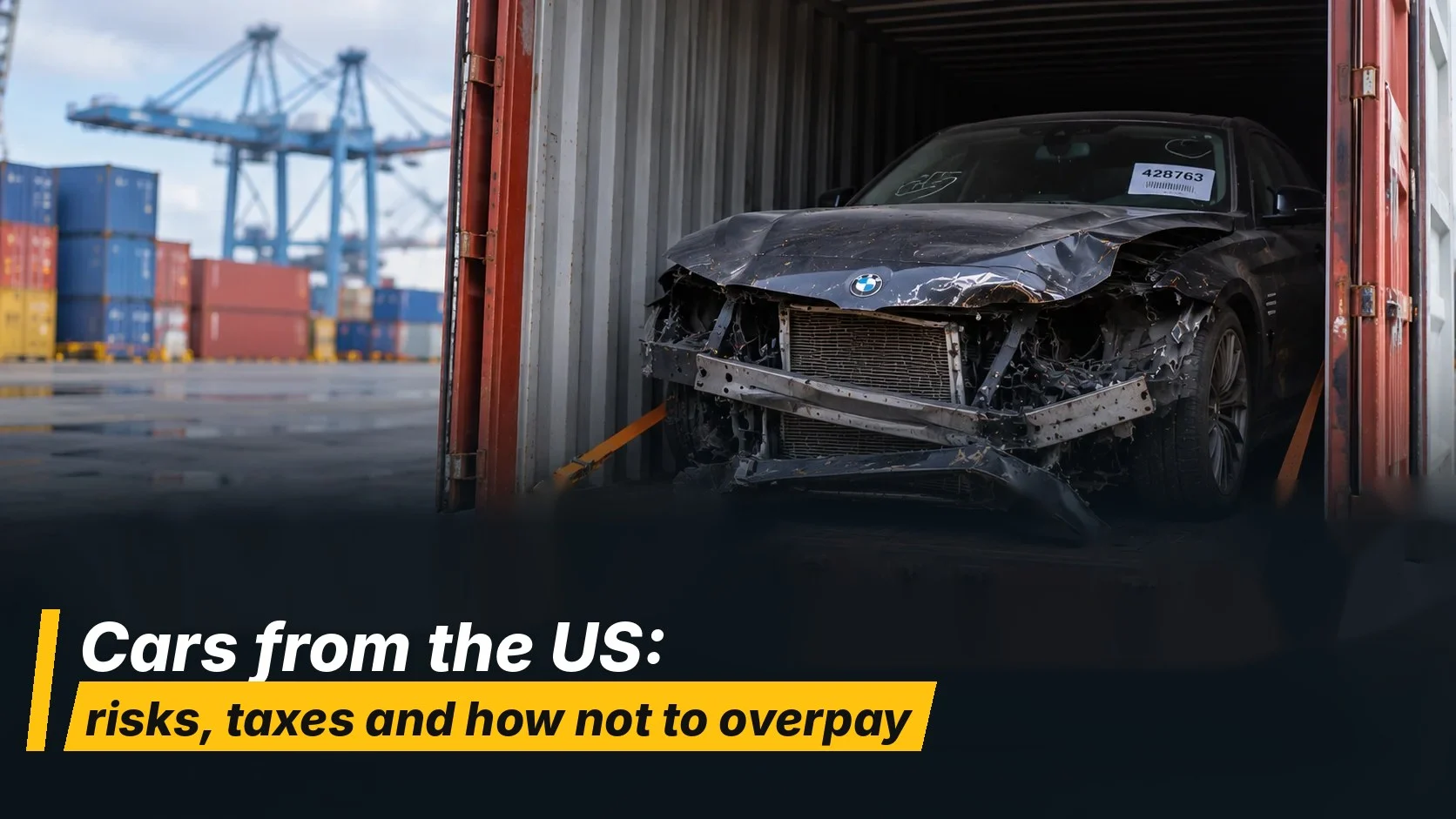
Most American cars that end up in Europe come from insurance auctions (Copart, IAAI). These are cars that the insurer has declared a total write-off or uneconomical to repair: following an accident, flooding, hail damage or theft. They are bought at a low price, repaired and then sold. This does not mean that every such car is of poor quality, but its price is low for specific reasons.
2 Be sure to check the vehicle’s history using the VIN
Articles about the history of cars in the US are usually accompanied by photographs. Before you go to view a car, check the VIN.
- Auction history: search for the VIN using the keywords ‘Copart’, ‘IAAI’, ‘bidfax’ or ‘stat.vin’. These often include photos showing damage prior to repair.
- Status: ‘Clean’ is the best option. ‘Salvage’ and ‘Rebuilt’ mean that the car has been written off. ‘Flood’ is the worst option, because water gradually damages the electronics, even years later.
- A Carfax or AutoCheck report shows the mileage, previous owners, as well as records of accidents and servicing.
- Compare the photos of the damage with what you can see in real life: does the repair work match the extent of the damage, and have the airbags and seatbelt tensioners been replaced?
3 What to check during an inspection
- Airbags: the SRS warning light should go out after the engine is started, and the diagnostic system should not show any safety system faults. After accidents, this is precisely where people most often cut corners.
- Signs of water damage: rust on the seat rails and screws under the panelling, sand or mud under the floor covering, a musty smell, and rusting joints.
- Bodywork geometry: uneven gaps, variations in paint thickness, welding marks on the side members.
- Mileage: In the US, the odometer displays miles. 100,000 miles is approximately 161,000 km. Make sure the seller isn’t listing miles as kilometres.
- A comprehensive diagnostic check that reads data from all control units, not just the engine.
4 Why might the tax (TEN) be several times higher?
In Latvia, road tax for cars first registered after 2008 is calculated on the basis of the CO₂ emission figures (g/km) listed in the CSDD register. From 2025, all rates will be increased by 10 per cent. American cars do not have European type-approval, so the CO₂ emissions figure in the register may be significantly higher than that of the same model sold in Europe. If there are no CO₂ emission figures in the register at all, the tax is calculated based on the kerb weight, engine capacity and power output.
5 What to do about tax
If a car from the US is already registered in Latvia, you can check the CO₂ emissions figures and the amount of tax due in the roadworthiness test details on the e-CSDD website or by entering the vehicle’s registration number. Before buying, compare this with the European version. If the car is not yet registered, bear in mind that the CO2 emissions figure may be higher than that of the European version, and factor this into the price. Before buying a car with a view to registering it, check with the CSDD or a certification company to find out what CO2 emissions figure will be specified for that particular model.
6 Customs, delivery and refitting
- Customs duties on imports into the EU: 10 per cent customs duty and 21 per cent VAT. Both amounts are calculated on the basis of the car’s value, including delivery and insurance, up to the EU port.
- Container delivery to a European port (Klaipėda, Bremerhaven, Rotterdam) and customs clearance: expect to pay several thousand euros plus port charges.
- Upgrades to meet European requirements: the rear indicators must be yellow, the speedometer must display km/h, and the headlights must comply with EU standards. Without these, the car will not be registered.
- Conformity assessment at the CSDD: a vehicle without a European Certificate of Conformity (CoC) must undergo a technical inspection prior to registration.
- Spare parts: some parts differ on the American versions (headlights, bumpers, electronics). Check whether they are available in Europe.
7 When an American car is a good choice
If the car has a clean title (no auction history), the repairs are of a high standard and properly documented, and customs duties have already been taken into account, then a car from the US could prove to be a good deal. Always check CO₂ emissions and taxes before buying, as the difference in annual running costs over several years could wipe out any savings.
© 2026 Autoradars.lv. Content protected by copyright. Republishing only with written permission from Autoradars.lv and a link to the source.
Comments (0)
Log in to comment. Log in
No comments yet. Be the first!