
DPF filter: why it clogs and what it costs to save it
It sits in the exhaust, asks for nothing and only reminds you it exists when an orange light comes on and the car suddenly refuses to pull. The diesel particulate filter is one of the most expensive small parts in a modern car. The good news: its fate depends much less on luck than on how you drive.
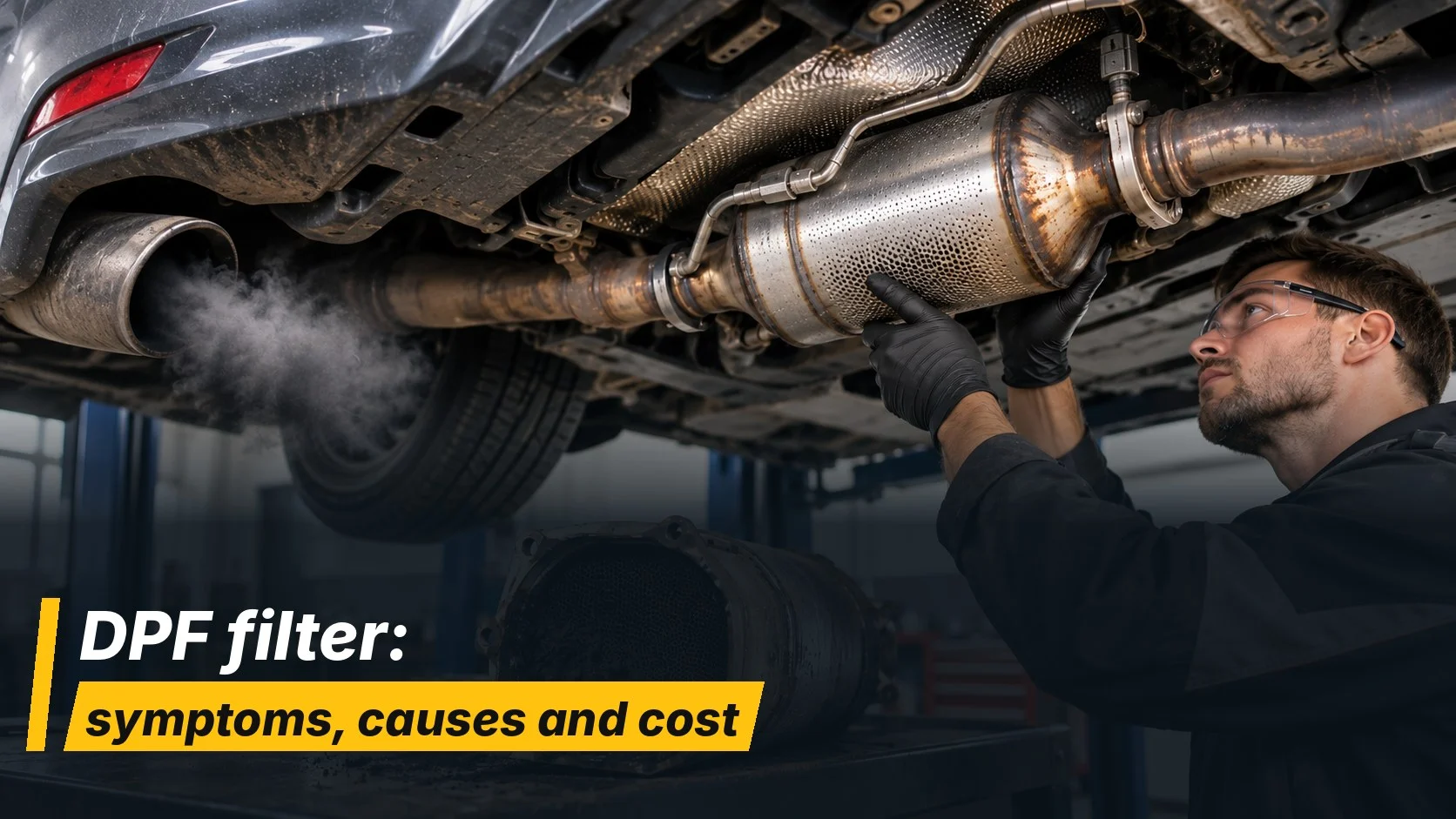
1 A small smoke trap with a big job
Remember old diesels leaving a black cloud behind every time the driver put his foot down? The DPF is why a modern diesel no longer does that. Inside the filter is a ceramic honeycomb: the gases pass through its porous walls, the soot stays behind.
The catch is obvious: if you only ever collect, one day you are full. So every now and then the filter cleans itself. This is called regeneration: the engine computer raises the exhaust temperature to around 600 degrees and the soot simply burns off. What is left is a little ash that builds up over years.
2 Town driving is the filter's worst enemy
Regeneration needs time and heat: some 10 to 20 minutes of steady driving at a decent speed. Now picture a typical day: 6 km to work, a traffic jam, 6 km back, a trip to the shop in the evening. The engine barely warms up, let alone burns off soot.
The computer starts a regeneration, but you are already parking and switching off. Next time it tries again. And again. Every unfinished attempt sprays extra fuel into the cylinders, and some of it ends up in the oil. That is why a diesel used only in town can see its oil level rise, and that is no miracle: diluted oil protects the engine less well.
3 How the car tells you something is wrong
A filter rarely fails out of the blue. It usually warns you, we just do not listen. The first sign is the DPF light: it does not mean "go to the garage now", it means "please give me a longer drive". Ignore it and the "Check engine" light follows, with the car dropping into limp mode. Climbing a hill like that feels like running with a rucksack full of bricks.
Other signs: fuel consumption slowly creeping up, the fan running after almost every trip, and the dipstick showing more oil than after the last change.
4 It is not always the driver's fault
Sometimes the filter clogs because the engine simply makes too much soot. The culprit can be a sticking EGR valve letting too much exhaust gas back into the cylinders, worn injectors or a turbo that does not deliver enough air. Another quiet saboteur is the differential pressure sensor: it measures how full the filter is, and if it lies, the computer either never starts a regeneration or starts one for no reason.
The oil matters too. DPF engines need low-ash (low SAPS) oil with the maker's approval. Ordinary oil leaves more ash when it burns, and regeneration cannot burn ash away. And one detail many people do not know: some cars will not start a regeneration with the tank almost empty.
5 What it costs in Latvia
The good news is that not every DPF light means a new filter. It all starts with diagnostics (€30-60): without it you might replace the filter and find the new one just as full a few months later, because the real cause is still there.
If the filter is not overloaded yet, a garage can run a forced regeneration with a diagnostic tool (€50-100). If it is too late for that, the filter is removed and cleaned on a special machine (€150-300), and it often comes back close to new. Only if the ceramic has cracked or melted do you need a new filter: aftermarket €400-1,000, original €1,500-4,000 or more.
6 And what about just removing it?
Some still offer it, and not long ago it even looked like a good deal. Not any more. Since 2026 the CSDD roadworthiness test measures the particle number in the exhaust of diesels registered from 2013. The limit is 1,000,000 particles per cubic centimetre, and a car without a filter exceeds it hundreds of times over. The result: a failed test and a car the next buyer will pay a lot less for. It is also illegal.
7 Buying a used diesel
Ask the seller how the car was used. If the answer is "only in town, to the nursery and back", give the filter extra attention. A diagnostic tool shows how full the filter is now and when the last regenerations happened. Look at the exhaust pipe too: fresh welds near the filter may mean it has been cut out.
And before you go to see the car, paste the listing link into Autoradars.lv: the report shows whether DPF and EGR problems are known for this engine and at what mileage they usually start.
© 2026 Autoradars.lv. Content protected by copyright. Republishing only with written permission from Autoradars.lv and a link to the source.
Comments (0)
Log in to comment. Log in
No comments yet. Be the first!